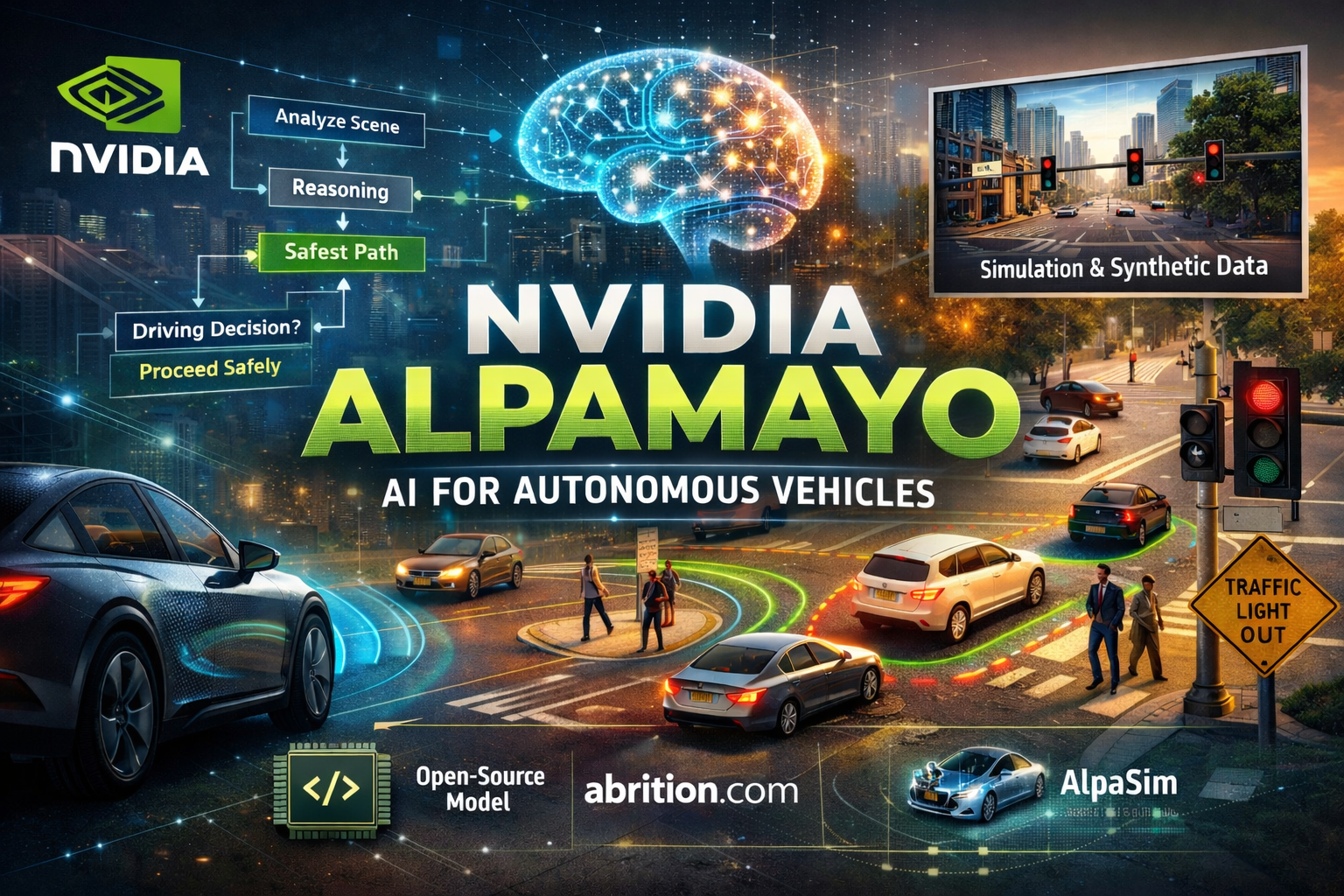
Announced at CES 2026 — a new open stack of models, simulators and datasets aimed at giving self-driving systems step-by-step reasoning for messy real-world driving.
Autonomous driving has made big strides, but the hardest part isn’t following lane markings — it’s handling the strange, rare, and unpredictable. At CES 2026 Nvidia introduced Alpamayo, a playbook designed to tackle exactly that: a family of open-source models, tools and data that help vehicles reason through complex edge cases the way a human driver might.
What Alpamayo is (in plain language)
Alpamayo is not a single product but a toolbox. At its center is a reasoning-capable vision-language-action model that helps an AV break a driving problem into steps, weigh options, and select a safe course. Around that core are simulation frameworks, synthetic-world generators and a sizeable open driving dataset — all intended to make training, testing and validating smarter driving behavior faster and more transparent.
Alpamayo 1 — the brain that reasons
The flagship model, Alpamayo 1, is a 10-billion-parameter model built to combine vision, language and action. It’s explicitly designed for chain-of-thought style reasoning: instead of outputting a single control command, it can decompose a scenario, consider alternatives, and arrive at a defensible action — useful for rare situations like traffic-light outages or unusual intersections where past experience is limited. Crucially for many teams, the code for Alpamayo 1 is openly available on Hugging Face, enabling customization and lighter-weight adaptations for production vehicles.
Tools, data and simulation — the rest of the stack
Nvidia packaged Alpamayo with several supporting components that matter for practical development:
-
Open driving dataset: Nvidia is releasing over 1,700 hours of driving data capturing a variety of geographies and difficult scenarios. That kind of long-tail data is valuable for teaching models how to behave in rare but safety-critical events.
-
AlpaSim: An open-source simulation framework available on GitHub, designed to recreate sensors, traffic and environmental conditions so teams can validate driving systems at scale without risking people or hardware.
-
Cosmos: Nvidia’s generative world models can produce synthetic environments and scenarios. Combined with real-world footage, synthetic data can expand coverage of unusual cases and speed testing cycles.
-
Developer workflows: The stack supports common engineering tasks — fine-tuning Alpamayo into smaller, faster variants for embedded systems, building auto-labelers to speed dataset annotation, and creating automated evaluators to judge whether a vehicle’s decision was sensible.
Why this matters
Three practical benefits stand out:
-
Better handling of edge cases — chain-of-thought reasoning helps systems generalize to novel situations instead of relying purely on memorized patterns.
-
Faster iteration for developers — open code, simulation and synthetic data let teams experiment and validate changes more quickly and cheaply.
-
Transparency and validation — models that can explain their decision process (reasoning steps) help engineers, regulators and auditors understand why a vehicle acted the way it did.
Realistic limits and considerations
Alpamayo packs potential, but it isn’t a silver bullet. A few pragmatic points for teams and regulators to keep in mind:
-
Validation remains essential. Open models and rich simulation don’t remove the need for rigorous, real-world safety testing and regulatory review.
-
Synthetic data gaps. Generated environments help coverage but can also introduce distribution mismatches; blending synthetic and real data carefully is key.
-
Explainability vs. reliability. Chain-of-thought outputs can improve interpretability, but they shouldn’t be mistaken for definitive proof of correctness — they’re another signal to be weighed in validation pipelines.
-
Compute and deployment. Even when fine-tuned, reasoning-capable models require thoughtful engineering to run efficiently on vehicle hardware.
What to watch next
With Alpamayo’s code and tools public, expect rapid experimentation from automotive OEMs, Tier 1 suppliers and startups. Look for early integrations that pair smaller Alpamayo-derived models with conservative decision stacks and heavy offline validation. Regulators and third-party auditors will likely focus on the model’s failure modes and the fidelity of synthetic-to-real testing.
Bottom line
Alpamayo represents a shift from purely pattern-driven autonomy toward models that attempt human-like reasoning about driving situations. By combining an open reasoning model with simulation and real/synthetic datasets, Nvidia is offering developers a practical toolkit for tackling the long tail of driving problems — but safe deployment will still depend on careful validation, conservative engineering, and close regulatory oversight.
Source: Techcrunch